Forestry Mulching in Ocala & Marion County
📞 Call (352) 780-7314Prices, the burn rules, and the tortoise rule on this page checked against the sources listed at the bottom on October 19, 2026.
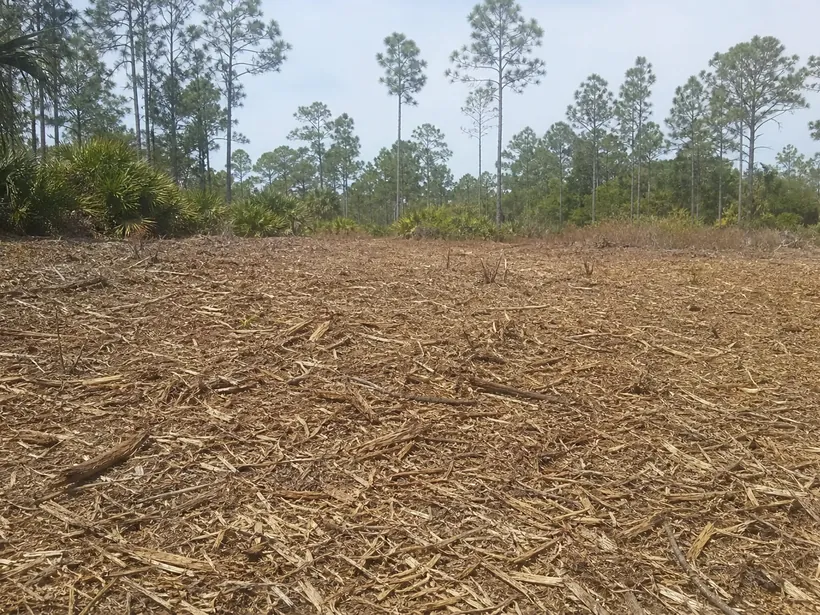
Forestry mulching is the fastest, cleanest way to reclaim overgrown Florida land: a single machine with a drum mulcher head grinds palmetto, vines, brush, and small trees into a mulch layer right where they stand. No burn piles waiting weeks for a permit day, no dump trucks, no scraped-bare topsoil. You walk out onto shaded, park-like land the same week we start.
Why does mulching fit Marion County land?
Most overgrown parcels here are pine-oak upland choked with saw palmetto and grapevine, exactly what mulching heads were built for. The ground-up layer does real work, too: it suppresses palmetto regrowth, holds moisture in our sandy soils, and prevents the erosion you get when land is bladed bare. On horse property, mulched understory means you can finally see your fence lines and your animals.
The sand is the other reason. A tracked machine with a mulching head rides on top of the ground instead of pushing it around, so a Fort McCoy scrub parcel or a sandhill lot off 475 comes out of the job with its topsoil where it started. That matters more here than in a county with clay under it.
What does forestry mulching cost in Ocala?
In Marion County, light-to-moderate growth runs $400 to $1,000 per acre, more when bigger trees are mixed in. That lines up with the national picture: HomeGuide's 2026 figures put forestry mulching at $400 to $800 per acre on average and up to $2,000 per acre for dense overgrowth, with a machine and operator at $1,000 to $2,500 per day. Expect a minimum charge in the $400 to $600 range on a small job, because the machine costs the same to haul out for a quarter acre as for five.
What moves the number: tree size and count (a 6-inch pine is quick, a 12-inch one is slow), how fine you want the mulch (a second pass makes it finer and takes longer), access for the trailer, and whether we are working around keeper trees one at a time. Compare all of that with clear-and-haul at $1,200 to $4,800 and up per acre and the case for mulching makes itself whenever the land just needs to be open and usable. The full table is in the 2026 cost guide.
How many acres can you mulch in a day?
Density is the whole answer. Light scrub mulches at 2 to 4 acres a day; dense understory with 4 to 8 inch trees runs 1 to 2 acres a day. HomeGuide's national average for a skid steer mulcher is 1 to 3 acres a day, which is about right for the mixed parcels we see most. Ten acres of palmetto flatwoods is a three-to-five day job. Ten acres of thick oak and pine regrowth is closer to two weeks, and at that point we usually talk about dropping the big stuff first and mulching behind it.
Will the palmetto come back?
Yes, and you should hear why before anyone sells you a permanent fix. Saw palmetto spreads by horizontal stems that run along and under the ground. The U.S. Forest Service describes it as exceptionally fire resistant: fire burns the fronds off and the plant resprouts from the root crown and those underground stems. A mulcher does the same thing a fire does, from the plant's point of view. It takes the top off and leaves the rhizomes alone.
The same source notes that saw palmetto does not regenerate well after mechanical work that uproots and cuts those stems. In plain terms: mulching knocks palmetto back hard and buys you a season or two of open ground, and a cheap maintenance pass every year or two keeps it that way. Grubbing the root mat out is what kills it, and that is a full clearing job with a different price. Frankly, for pasture edges, trails, and view corridors, the maintenance-pass plan is the better deal. For a house pad it is not.
Do you need a permit to mulch in Marion County?
Mulching understory is not tree removal, and most upland parcels in unincorporated Marion County clear their brush without a county permit. Three things override that. A gopher tortoise burrow: the FWC counts any work within 25 feet of a burrow as a disturbance, so we look for the sandy half-moon holes on every walk and plan the job around them. Protected trees: a mulcher will take down a small oak before you can stop it, so we flag the keepers and the specimen live oaks before the machine starts. And city limits: inside the City of Ocala the city runs its own tree review. The longer version is in our Marion County permit guide.
Mulch it, or pile it and burn it?
Burning is the old way to get rid of brush here, and it is cheap in fuel and expensive in waiting. Florida's open burning rule requires an authorization from the Florida Forest Service for pile burning, issued for a specific day, and the Forest Service's own page says escaped debris burning is one of the leading causes of wildfires in Florida. There are setback distances from occupied buildings, roads, and woods on top of that; we lay them out in the debris section of the home page. A mulching job has no pile. The brush becomes the ground cover and you are done the day the machine leaves.
What mulching won't do
Three things, and you should hear them before you book anyone. It leaves stumps in the ground. A drum head grinds them flush, but the roots stay, so nothing gets built on mulched land without grubbing first. It slows way down on trees over about 8 inches. A mulcher will eat a 12-inch pine, but you're paying for slow work; past that size we drop the tree first and mulch behind it, or the job wants an excavator. And the brush comes back, palmetto especially. A maintenance pass every year or two holds it, at a fraction of the first cut, but one mulching job is not a permanent fix.
Wet ground is the fourth thing. A tracked machine floats better than a wheeled one, but a low spot off SR 40 in August is still a low spot, and we'll wait for it to drain rather than rut it up.
Renting a mulcher versus hiring one
Every year somebody rents a skid steer with a mulching head to do their own five acres, and some of them call us in week two. The rental runs several hundred dollars a day before delivery and fuel, the teeth on the head cost real money when a rock or an old fence post finds them, and a first-time operator covers maybe a third of the ground a full-time one does. Hired mulching with an operator runs $1,000 to $2,500 a day industry-wide, and in Marion County that lands at $400 to $1,000 an acre on light to moderate growth. On an acre of light brush the rental can win. On five wooded acres it almost never does.
Mulching vs. bulldozing
- Topsoil: a dozer blades it into the debris pile; a mulcher leaves it in place
- Debris: dozer work ends in burn piles or haul-off fees; mulching ends in a finished ground layer
- Selectivity: mulching works around keeper oaks and pines tree by tree
- When the dozer wins: building pads, root grubbing, and grade changes. That's full clearing and dirt work, and we do those too
Horse farms and fence lines
Mulching earns its keep on the farms along 326, 225, and Highway 27, where the goal is to see the fence, ride the trails, and keep the oaks. The head works under the canopy and around keepers, and the mulch layer keeps the palmetto from closing back in for a season or two. For a straight corridor along wire, see fence line clearing.
Sources, checked October 19, 2026: HomeGuide, forestry mulching cost (per acre, per day, minimums) · U.S. Forest Service Fire Effects Information System, saw palmetto (Serenoa repens) · FWC gopher tortoise permits (25-foot disturbance rule) · Fla. Admin. Code 5I-2.006, open burning authorization · Florida Forest Service, burn authorizations · Florida Forest Service, wildland fire and defensible space · Marion County Land Development Code, tree protection
Common Questions
How much does forestry mulching cost?
Most Marion County mulching jobs run $400–$1,000 per acre for light-to-moderate underbrush, more for dense scrub with larger trees mixed in. It's usually the cheapest way to reclaim overgrown land.
How many acres can you mulch per day?
Light palmetto and scrub: 2–4 acres a day. Dense pine-oak mix with 4–8" trees: closer to 1–2. Vegetation density is the whole story.
Is mulching better than bulldozing?
For reclaiming overgrown land, yes: no burn piles, no hauling, topsoil stays put, erosion stays controlled, and the mulch layer suppresses regrowth. For building pads you'll still want clearing and grading.
Will the mulch kill the palmetto for good?
Mulching sets palmetto and vines back hard, but Florida scrub regrows, so a maintenance pass every 1–2 years keeps land open, which is far cheaper than the first cut.
What are the downsides of forestry mulching?
Stumps and roots stay in the ground, so you can't build on mulched land without grubbing first. It slows down and costs more on trees over about 8 inches. And the brush regrows, so plan on a light maintenance pass every year or two.
Do I need a permit to mulch my land in Marion County?
Usually not for brush on an upland parcel outside the City of Ocala. The exceptions are a gopher tortoise burrow (FWC counts any work within 25 feet as a disturbance), protected or specimen trees inside the mulching area, and parcels inside city limits. We screen for all three on the walk. The details are in our permit guide.
Ready to see the land under all that brush?
Free walk-and-quote anywhere in Marion County, most estimates inside 24 hours.
📞 Call (352) 780-7314